
Árpádházi Szent Erzsébet R. K. Egyházközség
Directory of Diaspora Pastors
Parish (Roman Catholic)
Parish (Roman Catholic)
Description
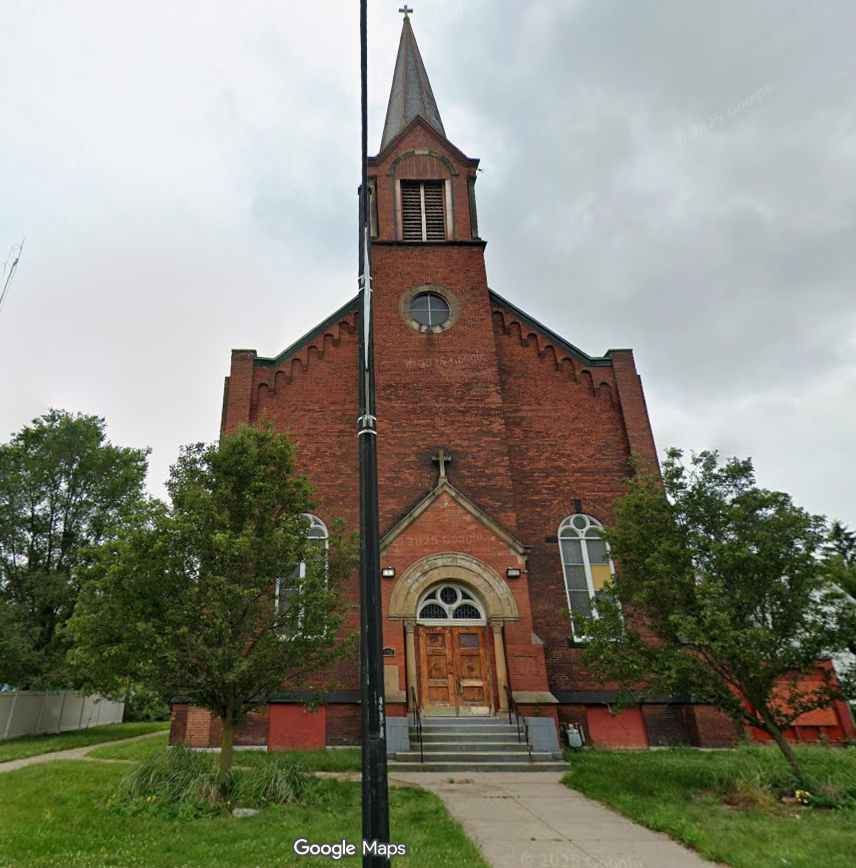
Hungarian immigrants began arriving in the Buffalo area as early as the 1880s, settling mainly on the outskirts of the city, in the Lackawanna, Tonawanda, and Depew regions. The community’s organized religious life began in 1906, when Father János Fröhlich brought together the Hungarian faithful and founded the First Hungarian St. Stephen’s Mutual Aid Society. This organization served not only social but also religious purposes: they decided to establish an independent parish and build a church. The initiative was also supported by Károly Böhm, the Cleveland parish priest, and as a result, St. Elizabeth Church was built on Grant Street by 1907.
In the early years, several priests served in succession, until Károly Böhm took over the leadership of the parish in 1910 and guided the community until 1923. During this time, the parish’s organizational life became firmly established: various church and social associations were formed, including the St. Elizabeth Women’s Association, the Altar Society, the Rosary Society, and the Holy Name Society. Community life was diverse: the Young Women’s Society was formed, as were the Girl Scout troop in 1920 and the Catholic Youth Council. The faithful actively participated in city life, for example in Labor Day parades, while also strengthening their sense of community through their own events—such as organizing bazaars and social gatherings. Böhm also invited the Social Sisters and founded the St. Vincent de Paul Society, which organized charitable activities.
In the 1920s and 1930s, the parish continued to develop. After a brief transitional period, Dénes Mosonyi became the parish priest in 1925; during his tenure, the Daughters of the Divine Savior took over education, and the parish school opened in 1934. The community maintained close ties with the Church in the motherland: in 1926, Cardinal Csernoch visited the parish, and several prominent church figures held retreats here. In 1935, Gyula Zákány became the parish priest, leading the parish for nearly three decades until 1963. During his tenure, the parish flourished: new community organizations were established, including the Marian Congregation and the girls’ scout troop, and both religious and cultural life were revitalized. Cardinal József Mindszenty’s visit in 1947 was a particularly significant event, symbolizing the connection between the diaspora and the motherland. Gyula Zákány was appointed papal prelate in 1959, a recognition of his service.
In the following period, Károly Meister, and then briefly János Sárvári, served the community, while the assimilation of the second generation was already becoming apparent. In 1969, János Skrapits became the parish priest, leading the parish for more than three decades, until 2000. During his tenure, the community sought to adapt to changing circumstances: they published a bilingual parish newsletter, youth organizations were active, and they preserved traditional religious festivals, such as the annual crowning of the statue of the Virgin Mary. In 1974, Cardinal Mindszenty visited the church again, which served as a further source of encouragement for the community.
After Skrapits’ death, the parish’s autonomy gradually diminished. Leadership was temporarily assumed by the priest of the neighboring Polish parish, while Hungarian pastoral care was provided by priests from other dioceses. This was part of a process affecting the majority of Hungarian parishes in the United States: due to declining numbers of parishioners and assimilation, maintaining independent ethnic parishes became increasingly difficult.
Developments in recent decades have reinforced this trend in Buffalo as well. The Hungarian character of St. Elizabeth Church has gradually receded into the background, and the parish’s operations have increasingly integrated into the local, multi-ethnic parish structure. Hungarian-language pastoral ministry is now largely occasional in nature and is carried out primarily by visiting priests. At the same time, the community’s historical heritage lives on: the memory of the former associations, the school, the scouting movement, and community events, as well as the traditions associated with the church, all contribute to ensuring that Buffalo’s Hungarian Catholic past is not forgotten.
The history of St. Elizabeth Parish in Buffalo thus serves as a good example of the general fate of Hungarian Catholic communities in the United States: a strong start and institution-building were followed by a long flourishing era, and then, from the second half of the 20th century, a gradual transformation and decline set in. Recent developments no longer signal the beginning of a new golden age, but rather the preservation of the community’s historical heritage within a changed ecclesiastical and social environment.
Related persons
Parish priests
Bíró Mihály
1907 - 1909 | plébános
Sources
- Miklósházy:2008 — A tengerentúli emigráns magyar katolikus egyházi közösségek története Észak- és Dél-Amerikában, valamint Ausztráliában, 1–5. Összeáll. Miklósházy Attila, sajtó alá rend. Ligeti Angelus, Kiss G. Barnabás, Szent István Társulat, Budapest, 2008. - 21-23.