Description
The history of St. Imre Hungarian Catholic Church in Fairfield is closely linked to the internal restructuring of Hungarian Catholicism in Connecticut during the interwar period. The starting point was the St. Stephen parish in Bridgeport, which had served as the primary spiritual center for the region’s Hungarian Catholics since the late 19th century. After World War I, however, particularly from the late 1920s and during the economic crisis of the 1930s, Hungarian families living in Bridgeport’s West End moved in increasing numbers to the suburban area of Fairfield. This demographic shift created a new pastoral situation: the faithful who settled in Fairfield remained tied to St. Stephen’s Parish in Bridgeport, with their pastoral care primarily provided by Father István Csernitzky, but it soon became clear that the new residential center required an independent Hungarian parish.
The independent parish was established in 1932. Following episcopal approval, a new parish was created in Fairfield for about a hundred Hungarian families, which was dedicated to the protection of Saint Imre. The chosen patron is particularly significant: in Hungarian historical and religious consciousness, Saint Imre is a symbol of purity, youth, and the Christian future, thus representing both national and religious identity for the parish founders. The community’s first liturgical center was a temporary chapel on Hibiscus Street; on New Year’s Day, more than five hundred faithful gathered there, which clearly demonstrates that the parish had a much broader base from the very beginning than the number of official founders alone would suggest.
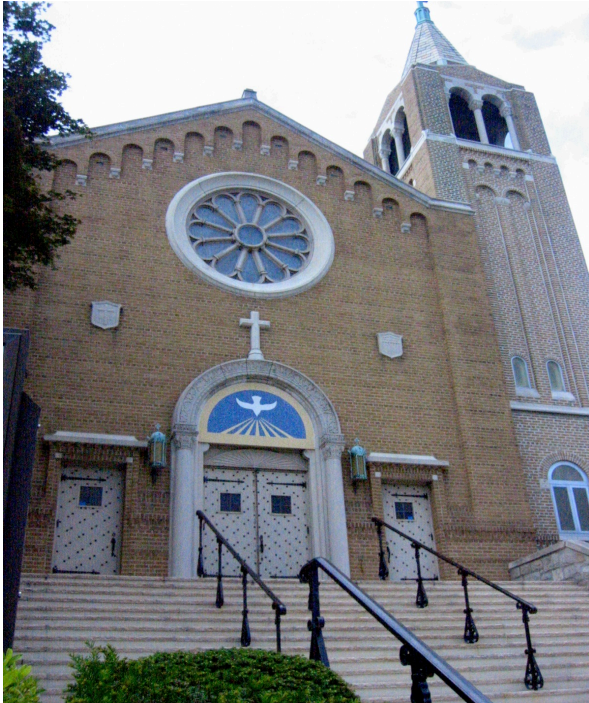
The bishop entrusted the parish to the care of the Franciscans of Transylvania and appointed Benedek Bíró, OFM, as its first pastor, who led the community for twenty years, from 1932 to 1952. His tenure can be considered the founding era of the St. Imre parish in Fairfield. In 1932, on Easter Sunday, the cornerstone of the church was blessed and laid, and on November 5 of the same year, the feast of St. Imre, the church and the altar were consecrated. The rapid pace of construction indicates that the community did not act merely out of liturgical need, but consciously sought to establish an institutional Hungarian Catholic center. At the same time, Benedek Bíró organized a network of church and social associations: the Altar Society, the Society of the Holy Name, the Rosary Society, the Women’s Association, the Men’s Community, the Marian Congregation, the Scouting movement, and later other youth organizations were established. These associations were the classic institutional forms of the era’s ethnic parishes: they simultaneously served religious practice, community cohesion, and the preservation of Hungarian cultural identity.
One distinctive feature of the parish’s early development was that, from the very beginning, it did not function exclusively as a closed Hungarian community. While it was clearly a parish with Hungarian roots and a Hungarian-speaking congregation, its catchment area gradually expanded beyond the original ethnic boundaries. This was later captured by the self-description “United Nations parish”: while preserving its Hungarian heritage, it became open to other ethnic groups as well. This did not mean abandoning its Hungarian character, but rather embedding it within Catholic universality.
Education was a central element of parish life from the very beginning. The school and religious instruction were led by the Daughters of Divine Love. The sisters first served at St. Stephen’s Parish School in Bridgeport, and later played a key role in Fairfield as well. A convent was built for them in 1952, and later a more modern religious house was also established. The school initially operated with a small enrollment, but by the mid-1950s the number of children had grown to such an extent that expansion became necessary. To this end, the cornerstone of the new school wing was laid in 1955, and the building was blessed and consecrated in 1956. The parish school operated as a full-fledged institution for thirty-one years, from 1956 to 1987, and played a role in the religious and academic education of nearly two generations. This is particularly significant in the context of the history of the Hungarian diaspora: the parish school was not merely a place of religious instruction, but one of the fundamental institutions for the transmission of language, festive customs, and community loyalty.
After Benedek Bíró’s death or retirement, the Franciscans continued to ensure the parish’s continuity. His successor was Ipoly Deésy, OFM, who led the parish until 1961. He is credited with organizing the Women’s Circle and expanding the school. During this period, the parish experienced significant growth: it comprised some six hundred families, and the community gave rise to several priestly and religious vocations. From this, we can conclude that the St. Imre parish reached its social and institutional peak in the 1950s. The parish was no longer simply a spiritual home for Hungarians who had left Bridgeport, but an independent, stable, and geographically significant Hungarian Catholic center.
Dénes Szőcs, OFM, succeeded Ipoly Deésy and led the parish until 1976. One notable aspect of his tenure was that in 1971, when Zoltán Seregély, the pastor of St. Stephen’s Parish in Bridgeport, passed away, Szőcs simultaneously assumed the duties of administrator there as well. This event goes beyond a mere personnel matter: it clearly illustrates the reconnection of the histories of the two Hungarian parishes. Fairfield was once a “daughter parish” of the Bridgeport parish, but after 1971, the historic mother church found itself in a crisis, and Fairfield became, in part, the stronger bearer of Hungarian Catholic continuity. In the same year, the last Mass was held at St. Stephen’s Church in Bridgeport, and the unification of the two Hungarian communities entered a new phase. Later parish tradition symbolically described this by saying that St. Stephen “gave life to his son,” St. Imre, and then, in his old age, his “son” provided him with spiritual continuity.
In the second half of the 20th century, the Fairfield parish simultaneously preserved its Hungarian roots and responded to the general structural changes in American Catholicism. Róbert Németh OFM led the community from 1977 to 1998, marking a new era of stability. The Hungarian-language pastoral ministry continued to play an important role during this time; Emery Szlezák OFM served in this capacity from 1986 to 2005. In 1989, a visit by Cardinal László Paskai strengthened the parish’s ties to the motherland. The liturgical life of the church became bilingual: in addition to English, the Hungarian Mass remained, reflecting changes in the internal structure of the diaspora. The community no longer consisted exclusively of first- or second-generation Hungarian-speaking parishioners, but also included those from mixed marriages, partially anglicized descendants, and Catholics of other ethnicities.
The closure of the school in 1987 was a major turning point. The decision was driven by a decline in the number of families, the social and demographic transformation of the neighborhood, and the general difficulties of maintaining Catholic schools. Despite this, the Daughters of Divine Love remained at the parish until 1995 and continued to provide religious instruction. Their departure marked the end of another era: the classic Hungarian Catholic model, built around nuns and a parish school, had come to a close by this time. The school building, however, did not become unusable; it later took on other educational and community functions, which clearly demonstrates the parish’s adaptability.
The Franciscan presence itself underwent a transformation. At the end of 1992, the Order’s Roman leadership dissolved the Franciscan ecclesiastical organization named after King Saint Stephen, which until then had served as one of the institutional frameworks for the diaspora ministry of Hungarian Franciscans of Central and Eastern European origin. This was driven by a decline in vocations, the new European situation following the collapse of communist regimes, and the global reorganization of the Order. From 1993, pastoral care of the parish fell to the friars of the Franciscan Province of New York, and in 2011, St. Imre Parish became a diocesan parish. This change is of historical significance: it brought to a close more than sixty years of direct service in Fairfield by the Hungarian Franciscans of Transylvania, yet it did not disrupt the life of the parish; rather, it placed it within a new institutional framework.
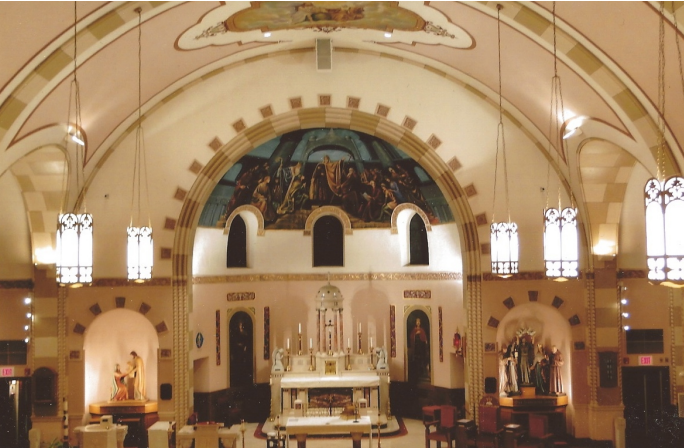
The restoration around the year 2000 was one of the most significant modern architectural interventions in the church’s history. The millennium and the need to appeal to younger families prompted a complete renovation of the interior. The sanctuary was adapted to the liturgical principles of the Second Vatican Council: a new altar, ambo, and font were installed, while the old high altar remained as the center of Eucharistic worship. New lighting, heating, and air conditioning systems were installed. On May 7, 2000, Bishop Edward Michael Egan blessed the restored church and consecrated the new altar. Following the restorations, the church became known locally as “Fairfield Cathedral,” a designation that, while not canonical but rather a community-based title, nonetheless effectively conveys the building’s prestige and representative character.
The interior symbolism of the church also bears witness to a conscious preservation of heritage. The three shrines—the altar groups dedicated to the Holy Family, the Franciscan saints, and the Hungarian saints—simultaneously represent the parish’s Catholic, Franciscan, and Hungarian identities. It is particularly significant that the Hungarian saints—Saint Stephen, Our Lady of the Hungarians, and Saint Imre—constitute a distinct diaspora “sacred memory” in which the national past lives on in liturgical and visual forms.
The survival of parish life has been ensured not only by institutions but also by the continuous cultivation of traditions. The Hungarian-language Mass, the blessing of Easter foods, the Resurrection procession, the feast days, and community events linked to Hungarian pastries and traditional foods all demonstrate that St. Imre Church in Fairfield remained a living bearer of Hungarian Catholic culture in the diaspora at the end of the 20th century and the beginning of the 21st century. At the same time, the parish’s self-identification has gradually shifted from an exclusively ethnic character toward a broader, territorial, and multilingual Catholic community. Due to changing demographics, high living costs, mixed marriages, and the mobility of younger generations, the composition of the parish has transformed, but it has not ceased to exist.
Based on all this, the history of St. Imre Church in Fairfield can be considered a representative example of Hungarian-American Catholicism. Its establishment was the result of self-organization by Hungarian immigrants; its development followed the classic diaspora model of Franciscan pastoral care, the parish school, and community life; and its later history clearly demonstrates how an ethnic parish was able to ensure continuity even amidst social, demographic, and ecclesiastical changes. St. Imre Church is therefore not merely a monument to local church history, but also an important institutional imprint of the Hungarian diaspora’s identity.
On January 2, 2020, the St. Imre Parish and the Holy Family Parish merged to form a single parish: the Holy Family and St. Imre Parish Church.