Description
The Basilian Order—a monastic community of the Byzantine Rite living according to the Rule of St. Basil the Great—is one of the leading institutions of the Hungarian Greek Catholic Church, with its headquarters in Máriapócs. In Hungary, the Order served the faithful by managing the Máriapócs shrine, conducting spiritual retreats, and carrying out extensive pastoral work. In the mid-20th century, however, historical events forced some members of the Order into exile. In 1956, three Basilian monks—Bazil Rakaczky, István Skinta, and József Erdei—left Hungary and settled in the United States, where they initially performed pastoral ministry at various parishes. Within a short time, other companions joined them, which made it possible to form an independent monastic community.
A decisive step in the community’s consolidation took place in 1963, when, with the support of the faithful, they purchased a farm in Matawan, New Jersey. There they established their monastic center with the aim of creating a kind of “new Máriapócs” for Hungarian Greek Catholics in America. Within a short time, the church and the monastery were built, and the community became increasingly organized. In 1969, church authorities officially approved the Community of the Basilian Fathers of Máriapócs, which solidified their operations both legally and ecclesiastically.
The Matawan center was not only a place of monastic life but also became an important spiritual center for the diaspora. The Basilian Fathers organized the American counterpart of the Máriapócs pilgrimage, regularly welcomed pilgrims, and held summer camps for young people, thereby strengthening religious and national identity. In addition, they served several Greek Catholic Hungarian parishes, so their activities extended far beyond the Matawan center. The community’s significance is evidenced by the fact that several high-ranking church officials visited them: Cardinal József Mindszenty in 1973, Cardinal László Paskai in 1989, and Bishop Attila Miklósházy, who also participated in the St. Stephen’s Day celebrations in 1992 and 1993.
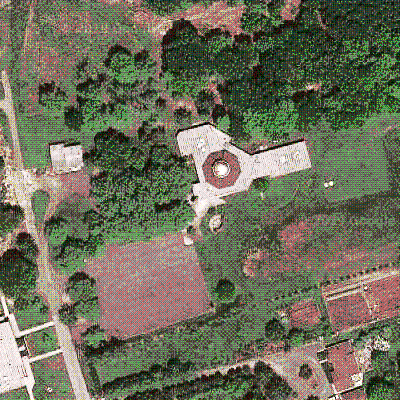
Proceeds from the bingo nights funded the construction of a new community building in 1973, and in 1981, a complex comprising a monastery and church complex was built, featuring a 100-seat community hall, a 200-seat chapel, an 8-bedroom pilgrim house, and a 30-seat dining hall.
The community was initially led by Bazil Rakaczky (1964–1966), then by István Skinta (1966–1971), and subsequently by József Erdei starting in 1971, who led the community for a longer period. During their tenure, the Basilian presence remained stable, yet even then the general problem facing American Hungarian Greek Catholic communities was already apparent: a decline in the number of the faithful, a lack of new members, and increasing assimilation.
The process of decline became evident by the end of the 20th century and the beginning of the 21st century. The lack of new monastic recruits, the dwindling number of aging members, and the dispersion of diaspora communities gradually made it impossible to sustain the community. The importance of the Matawan center declined; pastoral duties were increasingly taken over by other church structures, and pilgrimage activity also declined. Ultimately, the Community of Basilian Fathers of Máriapócs ceased to exist as an independent monastic community: the monastery ceased operations, the property and the former center lost their original function, and the members of the community continued their ministry elsewhere or retired. The Basilian buildings in Mariapoch-Matawan, USA, were sold in 2016 for non-ecclesiastical purposes.
The history of the Basilian community in Matawan thus paints a unique yet typical picture of a diaspora story. The monks, forced into exile after the revolution, established a new center that played an important spiritual and communal role in the lives of American Hungarian Greek Catholics for decades. At the same time, as a result of social and ecclesiastical changes at the end of the 20th century, this community also gradually ceased to exist, and today it lives on primarily as a historical memory in the collective memory of the diaspora.