Description
The establishment of the Hungarian Catholic community in New Jersey began in the early 20th century, when the pastoral care of the faithful was initially provided by Rev. László Perényi from Perth Amboy. The independent parish was established in 1914 under the leadership of Rev. Dr. János Szabó, who soon had a wooden church and a rectory built, laying the foundation for the community’s institutional life. In the following years, several pastors succeeded one another: in 1920, István Csáktornyái became the pastor, and then between 1922 and 1925, Rudolf Hudecz from Woodbridge ministered to the congregation.
The first major turning point in the community’s history was the fire of 1925, when the wooden church burned down. The reconstruction is attributed to József Szabó, who built a new church, thereby ensuring the continuity of the parish. During the tenure of László Csányi, appointed in 1928, the parish not only stabilized but also underwent significant community and social development. Various associations were formed one after another: the Catholic Men’s Circle, the St. James Youth Club, the Mothers’ Circle, and the St. Elizabeth Girls’ Club, which, in addition to religious life, also strengthened Hungarian community identity.
In the mid-1930s, Gyula Kiss briefly led the parish, followed again by László Csányi, but the true organizational revival began in 1937 with the arrival of Franciscan friar Father Márk Hajós. His initial task was to settle the debts, but his activities went far beyond this. He carried out extensive community-building work: he invited the Sisters of Divine Love to organize education, and founded numerous religious and social organizations, including the Society of the Holy Name, the Marian Congregation, the religious education movement, the St. Cecilia Choir, the Scouting movement, and the Young Married Couples’ Circle. The intensity of parish life is evidenced by the fact that three Masses were held on Sundays, one of which was already conducted in English, reflecting the community’s gradual linguistic and social transformation.
After World War II, Antal Huber’s seventeen-year tenure as parish priest (1946–1964) brought relative stability, after which János Chonkó took over. In the decades that followed, however—as with most Hungarian parishes in the United States—a slow decline began here as well: the number of parishioners decreased, the use of the Hungarian language declined, and the community increasingly assimilated into the local, English-speaking church structure.
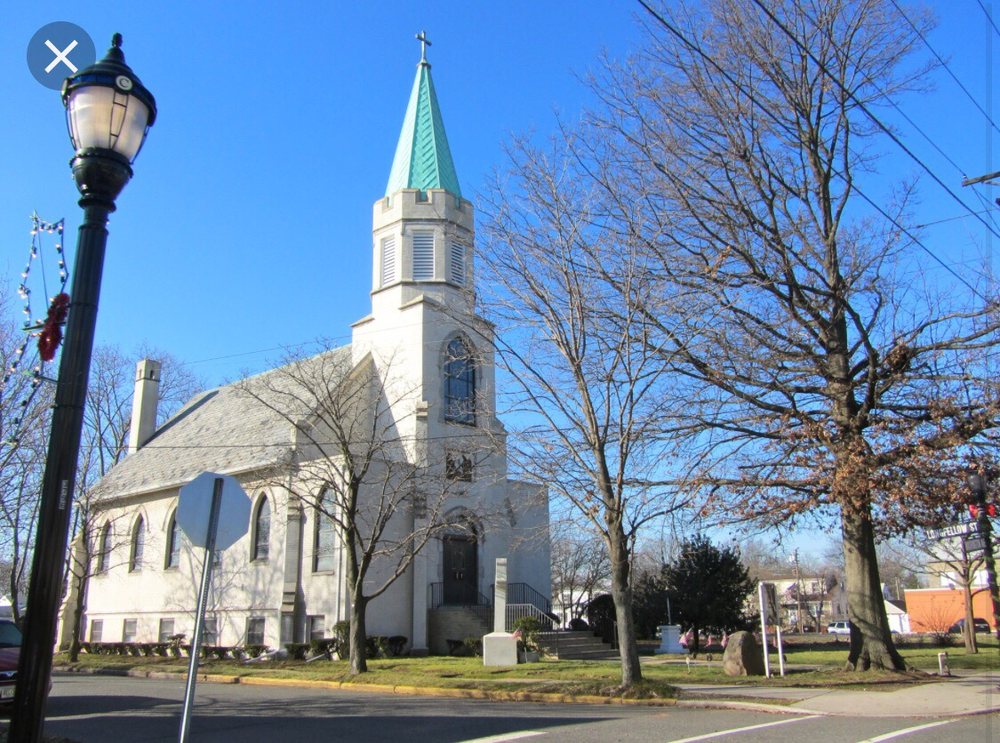
Developments in recent decades have cemented this process. In 2010, the parish was merged into the Divine Mercy Parish, marking the institutional end of its Hungarian ethnic character. The church building remained standing for a while longer, but was eventually sold to the city in 2018, and thus the community’s former center lost its original function.
The history of the parish thus follows a clear trajectory: the institution, established and built by immigrants, flourished between the two world wars, then gradually transformed and weakened in the second half of the 20th century, until it finally ceased to exist as an independent parish at the beginning of the 21st century. The latest developments no longer concern the renewal of the community, but rather its historical conclusion: the former Hungarian church today serves more as a memorial to a once-vibrant and significant diaspora community.