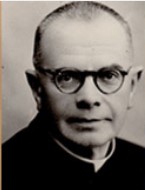
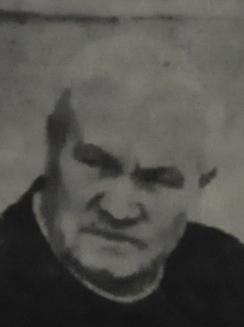
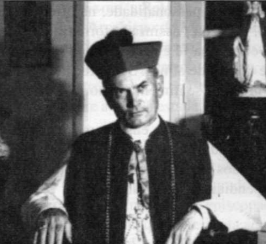
He entered the Salesian Order in 1906 and took his vows in 1910. He was ordained a priest in Madrid, Spain, in 1919. He is credited with founding the Salesian Order’s theological college in Péliföldszentkereszt, and he also established ten new houses for the Order. He developed the Order’s high school in Nyergesújfalu into a state-recognized institution and established the Society of the Daughters of Mary Help of Christians (Don Bosco Sisters) in Hungary (1937). During the Holocaust, he worked with Nuncio Angelo Rotta to save Jews; for this, he was arrested and tortured, and was released only through the nuncio’s intercession (1944). He left the country in 1948.
According to the Salesian Order’s obituary:
He was born in the village of Csősz (Veszprém County). The Salesian Bulletin, which was distributed in his hometown, introduced him to the Salesians. In 1906, he left for Cavaglia. He made his vows in Lombriasco in 1910. He began his probationary year in Novara and continued it in Spain. There he completed his theological studies and was ordained in Madrid in 1919. In 1920, he was assigned to Nyergesújfalu, and after holding several positions of responsibility, he served as Provincial Superior of the Hungarian Province from 1933 to 1948.
During his term as Provincial Superior, our province experienced a sudden upswing. His name is associated with the founding and flourishing of the Salesian Don Bosco Printing House in Rákospalota. But it was under his leadership that our houses were opened in Mezőnyárád, Mosonmagyaróvár, Balassagyarmat, Gyula, Borsodnádasd, Pestszentlőrinc, and Nagybánya (Romania). It would take too long to list all these foundations. But it was not only the houses that multiplied; the ranks of our confreres also grew steadily.
Then came World War II. Even in difficult times, János Antal proved himself a great man. He opened our houses to the persecuted, who found a home here. For this reason, the members of the order were harassed more than once, and were even assaulted on many occasions. János Antal was also dragged away and assaulted. His life was saved by the papal nuncio at the time.
After the bloody war, he set about rebuilding and founding new houses with great enthusiasm. It was then that the Salesian houses in Cegléd, Miskolc, Sajólád, and Tanakajd were opened.
It is no wonder that his health was worn down by the intense work. His superiors summoned him to Turin, so in 1948 he left his beloved homeland and the Hungarian Province. Instead of a well-deserved rest, however, he was given new assignments. In Turin, he served as secretary to Don Tirone; in 1951, he became provincial superior in Ecuador.
Barely a year later, the convened General Chapter elected him universal catechist, that is, spiritual director. Thus, a Hungarian Salesian became one of the first in the Salesian world. The whole world came to know the Hungarian János Antal! The little peasant boy had become a man of renown.
He remained in this position until 1965.
In the following years, he was a sought-after confessor and spiritual director. Due to a progressively worsening stroke, he sought relief in Piosasco, near Turin, but the angel of death came for him almost unexpectedly. He was 74 years old.
Domestic service locations
From
To
Place
Country
Church / institution
Position
1920
1921
Nyergesújfalu
Hungary
academic advisor
1921
1922
Péliföldszentkereszt
Hungary
director of the monastery
1922
1924
Budapest
Hungary
Segítő Szűz Mária Lelkészség
director of the monastery
1924
1926
Budapest
Hungary
Rákospalota – Clarisserium
Director of the House, founder of the Don Bosco Printing Press
Antal János SDB: personal record. In: Historical directory of Hungarian, Hungarian-descended, and Hungarian-speaking clergy serving abroad. Available at: https://www.diaszporalelkipasztorok.hu/persons_v2/view.php?id=13 (accessed: 2026-04-05).