
Szent István R. K. Egyházközség
Directory of Diaspora Pastors
Parish (Roman Catholic)
Parish (Roman Catholic)
Description
The history of the St. Stephen Hungarian Catholic Parish in St. Louis is linked to a relatively late phase of Hungarian immigration to the city. In the 19th century, Hungarians appeared in St. Louis only sporadically, including Ágoston Haraszthy, József Pulitzer, and, in 1852, Lajos Kossuth. However, a more permanent Hungarian community did not take shape until around the turn of the century, when economic emigration and, later, the 1904 World’s Fair attracted more Hungarians to the state of Missouri and the St. Louis area.
Hungarians first organized themselves into secular and cultural associations. The St. Stephen Society, the Petőfi Cultural Society, the Hungarian House, women’s relief societies, and the local Hungarian press all indicated that the community already had a social life, but did not yet have its own Catholic pastoral center. Several attempts were made to organize the Hungarian Catholics: however, the efforts of Antal Hegyi, Károly Böhm, József Reiner, S.J., Ödön Neurihrer, Menyhért Érdújhelyi, and Hubert József Eggemann did not lead to the establishment of a permanent parish. The plan for an independent Hungarian church that emerged in 1931 also failed.
The turning point came in 1933–1934, when János Gyarmathy, a priest from the Diocese of Kaposvár, arrived in America and began celebrating Hungarian Masses in St. Louis. In 1934, the Hungarian congregation acquired its own church: they purchased a former Methodist church at the corner of 11th Street and Chouteau Street. This became St. Stephen of Hungary, or the St. Stephen Hungarian Catholic Church, which served the local Hungarian community for 22–23 years.
Father Gyarmathy not only established a liturgical center but also founded community organizations. He brought the women together in the Altar Society, the men in the Holy Name of Jesus Association, and the young people into separate clubs. In addition to religious life, the parish became an important local guardian of Hungarian identity.
After World War II, the community’s numbers dwindled, but refugees from the People’s Republic of Hungary, followed by Hungarian refugees from 1956, breathed new life into the parish. The Hungarian parish, together with the NCWC, assisted the new arrivals. In 1957, however, St. Stephen’s Parish was closed, and the Hungarian faithful were given the former German church, St. Mary of Victories, for their use. From that point on, this historic church became the spiritual home of St. Louis’s Hungarian Catholic community.
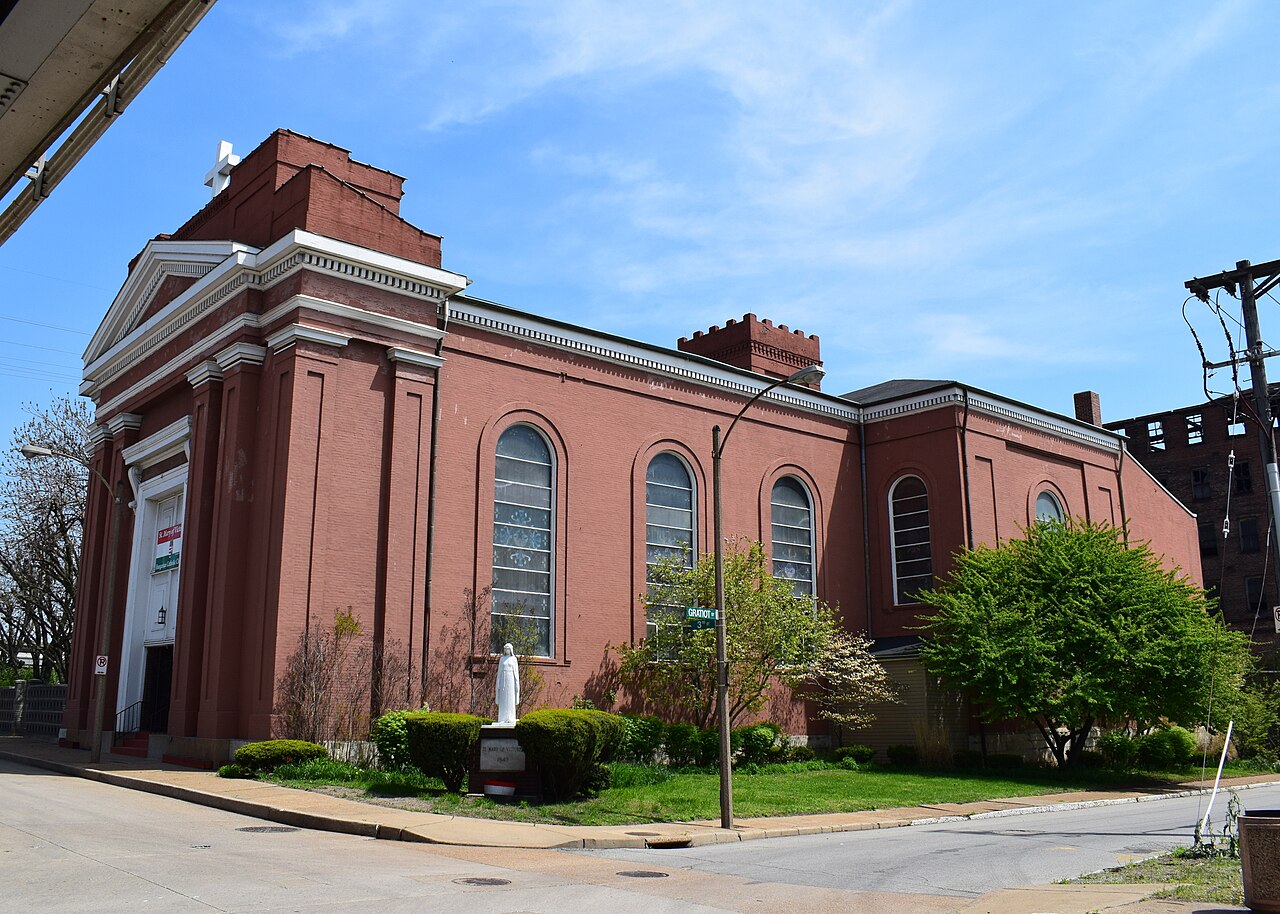
St. Mary of Victories Church is a significant landmark in church history in its own right. Founded in 1843, originally for German Catholic immigrants, it is one of the oldest Catholic churches in St. Louis. By the mid-20th century, the German community had dwindled, so the Hungarians’ takeover gave the building a new purpose. The church later became known as the “Hungarian church” and has preserved traces of the Hungarian presence in its sanctuary, liturgical objects, and the community’s collective memory.
János Gyarmathy retired in 1957 and then moved to Colorado Springs, where he was murdered under tragic circumstances in 1961. He was succeeded by István Vrabély, followed by Alfonz Skerl from 1962, and then by Gilbert Mihályi, a Premonstratensian monk, who served the Hungarian community from 1970. Later, Tibor Furák, OSM, and then József Somos served as pastors of the community between 1978 and 1991. After Father Somos’s departure, St. Louis was left without a Hungarian priest, but the archdiocese appointed an American pastor to serve the community.
St. Stephen’s Church thus functioned as an independent Hungarian parish church from 1934 to 1957, but its legacy did not end with its closure. The community’s history continued at St. Mary of Victories Church, which became an important American memorial site for Hungarian refugees, the 1956 revolutionaries, and their descendants. The history of Hungarian Catholicism in St. Louis is thus linked to two churches: the short-lived but authentically Hungarian-founded St. Stephen’s Church, and the historic St. Mary of Victories Church, which became the bearer of the Hungarian Catholic presence after 1957.
The original church of the St. Stephen Hungarian Catholic parish no longer exists. The former Methodist church, purchased in 1934 and located at the corner of 11th Street and Chouteau Street, served the Hungarian Catholic community in St. Louis until 1957; however, the parish subsequently relinquished the building. During subsequent urban development, the neighborhood underwent significant changes, and the site of the former church is now occupied by industrial and manufacturing facilities; according to sources, the area became part of the Purina corporate complex.
However, the history of the Hungarian community did not end with the closure of St. Stephen’s Church. In 1957, the congregation was granted use of one of the city’s oldest Catholic churches, St. Mary of Victories Church, which was originally built for German Catholic immigrants in the mid-19th century. The Hungarians converted the former school building into a parish house, and from that point on, Hungarian pastoral work continued there.
St. Mary of Victories Church still stands today, and its historical significance is underscored by its inclusion on the National Register of Historic Places. Although the size of the Hungarian community has declined significantly in recent decades, the church continues to preserve the memory of the Hungarian Catholics of St. Louis. Although Hungarian-language pastoral services are no longer as regular as they were in the mid-20th century, the building remains the most important landmark of the local Hungarian Catholic heritage. Thus, the history of the Hungarian Catholic community in St. Louis is now linked not to the former St. Stephen’s Church, but to St. Mary of Victories Church, which for more than six decades has been a symbol of the continuity of the Hungarian presence in the city.
Related persons
Parish priests
Gyarmathy János Mihály
1933 - 1957 | plébános
Mihályi Imre Gilbert O.Praem
1971 - 1974 | plébános
Furák István Tibor OSM
1978 - 1985 | plébános
Sources
- Miklósházy:2008 — A tengerentúli emigráns magyar katolikus egyházi közösségek története Észak- és Dél-Amerikában, valamint Ausztráliában, 1–5. Összeáll. Miklósházy Attila, sajtó alá rend. Ligeti Angelus, Kiss G. Barnabás, Szent István Társulat, Budapest, 2008.