Description
The history of the Hungarian Catholic community in Bethlehem is closely intertwined with the development of one of Pennsylvania’s most significant industrial cities. At the turn of the 19th and 20th centuries, an increasing number of Hungarian workers arrived in South Bethlehem, where they found livelihoods primarily in the rapidly expanding steel industry, especially at the Bethlehem Steel mills. Although their numbers initially numbered only a few hundred, they soon realized that they needed their own parish to preserve their identity and faith. They organized a fundraising drive on their own, and with the money they raised, they requested permission from the Archdiocese of Philadelphia to establish a Hungarian parish and appoint a Hungarian pastor.
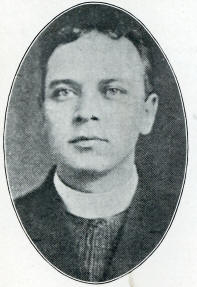
The request was granted, and on June 30, 1903, the Archdiocese appointed Sándor Várlaky as the first pastor of the newly formed Hungarian parish. The energetic pastor quickly organized the community, purchased two lots in the South Bethlehem neighborhood, at what is now 910 East Fourth Street, near Hayes Street, where construction of the first church began on October 1, 1903. Construction proceeded at a rapid pace, so that by April 1, 1904, Holy Mass could already be celebrated in the new church. Until then, the Hungarian parishioners had gathered for worship at the Italian Catholic church.
The growing community soon outgrew its first buildings. They purchased another lot adjacent to the two existing ones, and in 1909 they began construction of the school, which was completed by 1910. The Hungarian parish thus became not only a pastoral center but also an educational hub, where future generations could nurture both their native language and their Catholic faith.
After nine years of fruitful service, Sándor Várlaky left Bethlehem in 1912. He was succeeded by Lajos Kovács, whose tenure, however, was overshadowed by serious internal strife. As a result of disagreements within the parish, a group of parishioners broke away from the community and founded their own Hungarian Catholic parish, which built a church on Ötödik Street. The split deeply affected the original parish, causing a temporary lull in its activities.
To resolve this difficult situation, János Schimkó was appointed head of the parish on October 15, 1913. Through tireless work, he succeeded in restoring the community’s unity, but the strenuous demands of his ministry took a toll on his health. Due to his illness, István Moravetz was assigned to assist him, and in March 1918, József Reseterics became the administrator. János Schimkó passed away on June 20 of that same year, and József Reseterics permanently took over the leadership of the parish.
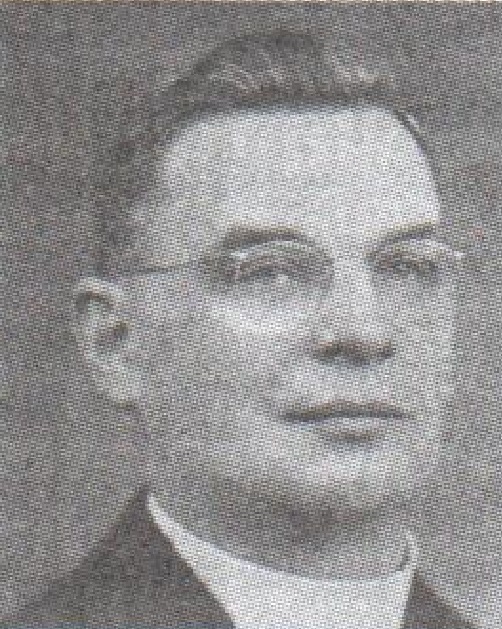
József Reseterics’s tenure ushered in a new era in the history of the Hungarian Catholic community in Bethlehem. When he took over the parish, he was faced with significant debts, internal difficulties, and unfavorable economic conditions. However, by rallying the parishioners, he managed to settle the finances in a short time, and by August 31, 1918, the parish had paid off all its debts. Thereafter, the community turned its attention to plans for building a larger, more dignified church to replace the old basement church.
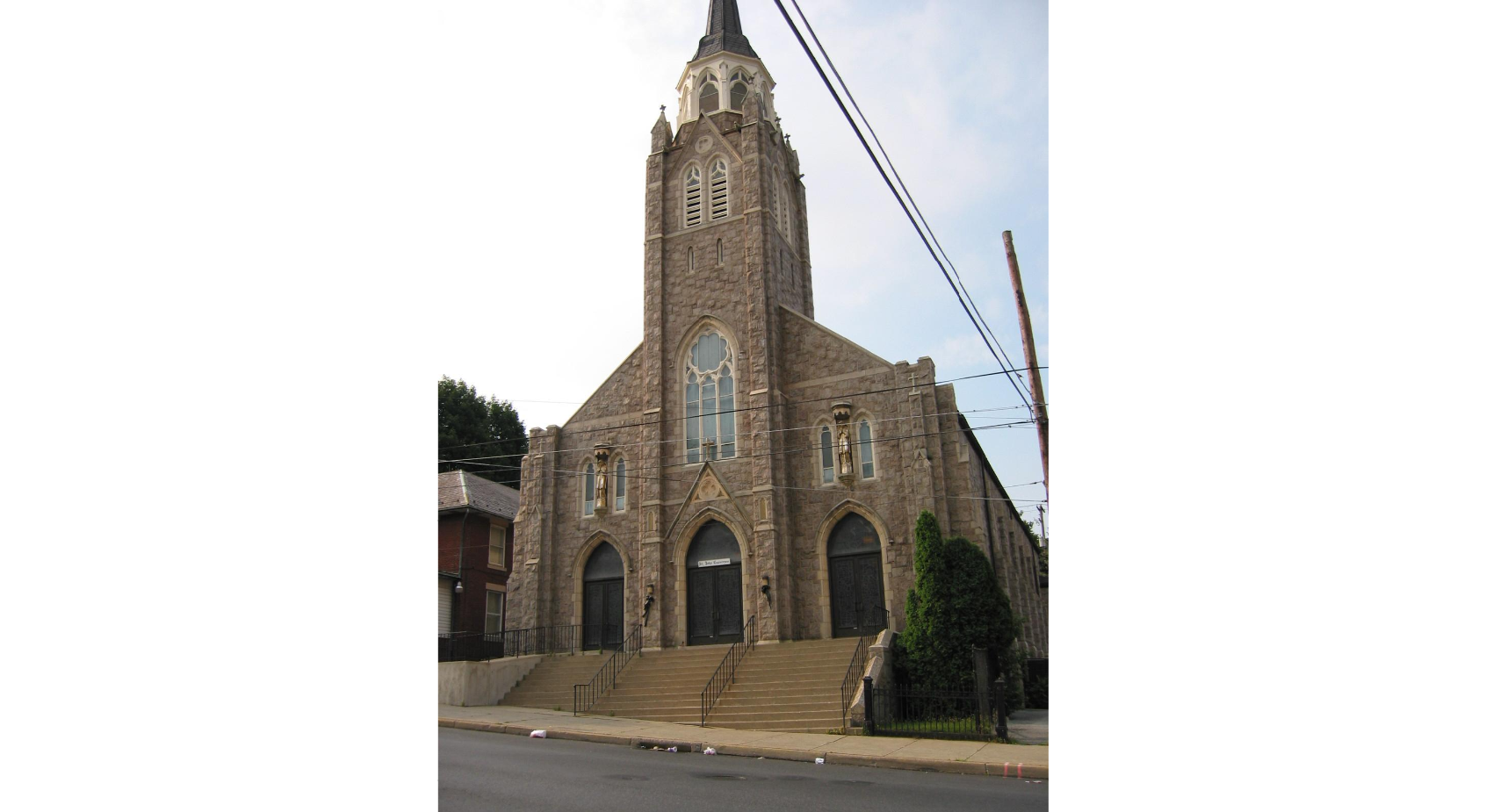
Although the World War delayed the project by several years, the decision to build the new synagogue was made in 1920. Families pledged their contributions toward construction, and fundraising began. The ceremonial groundbreaking took place on May 7, 1922; the cornerstone was laid on August 20, 1922; and the monumental new church was consecrated on September 3, 1923. The new church, built in the Gothic style, was dedicated to St. John of Capistrano. The consecration was preceded by a spectacular procession featuring Hungarian flags, young people dressed in traditional folk costumes, Hungarian cadets, and various associations, transforming the streets of South Bethlehem into a true Hungarian celebration.
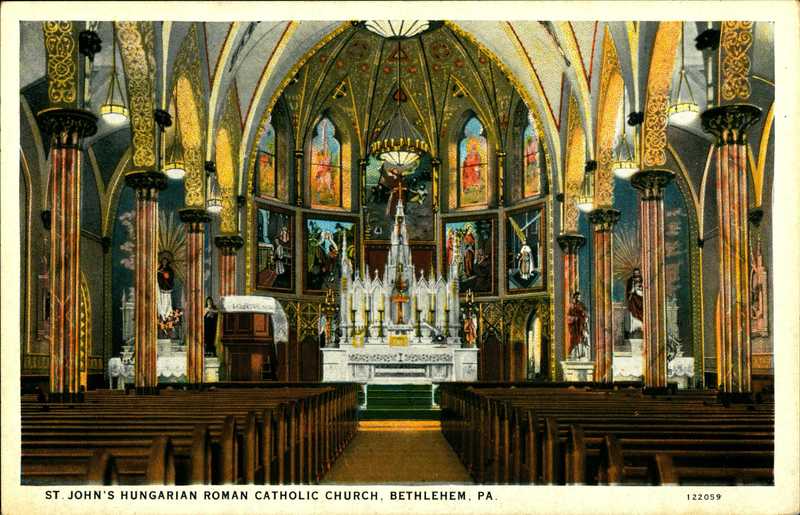
The spacious parish house was completed at the same time as the new church and was fully furnished in a short time thanks to donations from the parishioners. In the following years, the parish continued to grow: In 1923, new bells were acquired; in 1924, a new organ was consecrated; in 1926, an ornate Stations of the Cross was erected; and the church was then adorned with valuable carpets. In 1928, on the twenty-fifth anniversary of the parish’s founding, the interior painting of the church was completed, and in 1929, the nuns’ convent was built. All of this was largely due to the tireless organizational efforts of József Reseterics and the exemplary generosity of the parishioners.
Between the two world wars, the St. John Capistrano Parish became one of the most important centers of Hungarian life in South Bethlehem. Its school, associations, charitable organizations, cultural events, and celebrations played not only a religious but also a social role. It grew into a defining institution in the life of the local Hungarian community, and local historical research also recognizes it as one of South Bethlehem’s most significant ethnic parishes.
József Reseterics led the parish for nearly half a century, and his work shaped its character. He was succeeded by Antal Molnár, who carried on his predecessor’s legacy: he had the church renovated, modernized the interior, and prepared for the church’s 70th anniversary. During his tenure, in 1974, Cardinal József Mindszenty also visited the Hungarian church in Bethlehem during his tour of the United States. With its unique decorations, the church commemorated the victory of St. John of Capistrano and János Hunyadi at Nándorfehérvár, a tradition still preserved today by the noon bell ringing.
Although more Hungarian refugees arrived in Bethlehem after World War II, beginning in the 1960s, assimilation, the spread of the English language, and a decline in Hungarian immigration gradually reduced the number of Hungarian parishioners. The parish school closed, and the community grew increasingly older, while all of South Bethlehem’s ethnic parishes struggled with similar problems.
During a comprehensive reorganization of the Diocese of Allentown in 2008, the St. John Capistrano Hungarian parish was officially dissolved as an independent parish and, together with the Italian, Polish, Slovak, and Slovenian parishes into the newly established Incarnation of Our Lord Parish. This marked the end of the Hungarian parish in Bethlehem’s more than century-long history as an independent parish.
The former church building still stands at 910 East Fourth Street and is one of the most important surviving reminders of the Hungarian Catholic presence in Bethlehem. Although it no longer functions as a Hungarian parish, the building remains a defining part of South Bethlehem’s multiethnic Catholic heritage, serving as a reminder of the era when Hungarian steelworkers and their families, through their own efforts, built a church, a school, and a thriving community in one of Pennsylvania’s most important industrial cities.